Main menu

  • Content
    • Current Issue
    • Advance Access
    • Archive
    • Supplements
    • Special Collections
    • Topic Collections
  • For Authors
    • Instructions for Authors
    • Tips for Writing About Programs in GHSP
      • Local Voices Webinar
      • Connecting Creators and Users of Knowledge
    • Submit Manuscript
    • Publish a Supplement
    • Promote Your Article
    • Resources for Writing Journal Articles
  • About
    • About GHSP
    • Editorial Team
    • Advisory Board
    • FAQs
    • Instructions for Reviewers

User menu

  • My Alerts

Search

  • Advanced search
Global Health: Science and Practice
  • My Alerts

Global Health: Science and Practice

Dedicated to what works in global health programs

Advanced Search

  • Content
    • Current Issue
    • Advance Access
    • Archive
    • Supplements
    • Special Collections
    • Topic Collections
  • For Authors
    • Instructions for Authors
    • Tips for Writing About Programs in GHSP
    • Submit Manuscript
    • Publish a Supplement
    • Promote Your Article
    • Resources for Writing Journal Articles
  • About
    • About GHSP
    • Editorial Team
    • Advisory Board
    • FAQs
    • Instructions for Reviewers
  • Alerts
  • Find GHSP on LinkedIn
  • Visit GHSP on Facebook
  • RSS
ORIGINAL ARTICLE
Open Access

Effects of a Community-Based Program on Voluntary Modern Contraceptive Uptake Among Young First-Time Parents in Cross River State, Nigeria

Gwendolyn Morgan, Anjala Kanesathasan and Akinsewa Akiode
Global Health: Science and Practice December 2020, 8(4):783-798; https://doi.org/10.9745/GHSP-D-20-00111
Gwendolyn Morgan
aInternational Business & Technical Consultants, Inc., Vienna, VA, USA.
  • Find this author on Google Scholar
  • Find this author on PubMed
  • Search for this author on this site
  • For correspondence: gwendolyn.morgan99{at}gmail.com
Anjala Kanesathasan
bIndependent consultant, Washington, DC, USA.
  • Find this author on Google Scholar
  • Find this author on PubMed
  • Search for this author on this site
Akinsewa Akiode
cResearch & Communication Services, Abuja, Nigeria.
  • Find this author on Google Scholar
  • Find this author on PubMed
  • Search for this author on this site
PreviousNext
  • Article
  • Figures & Tables
  • Info & Metrics
  • Comments
  • PDF
Loading

Figures & Tables

Figures

  • Tables
  • FIGURE 1.
    • Download figure
    • Open in new tab
    • Download powerpoint
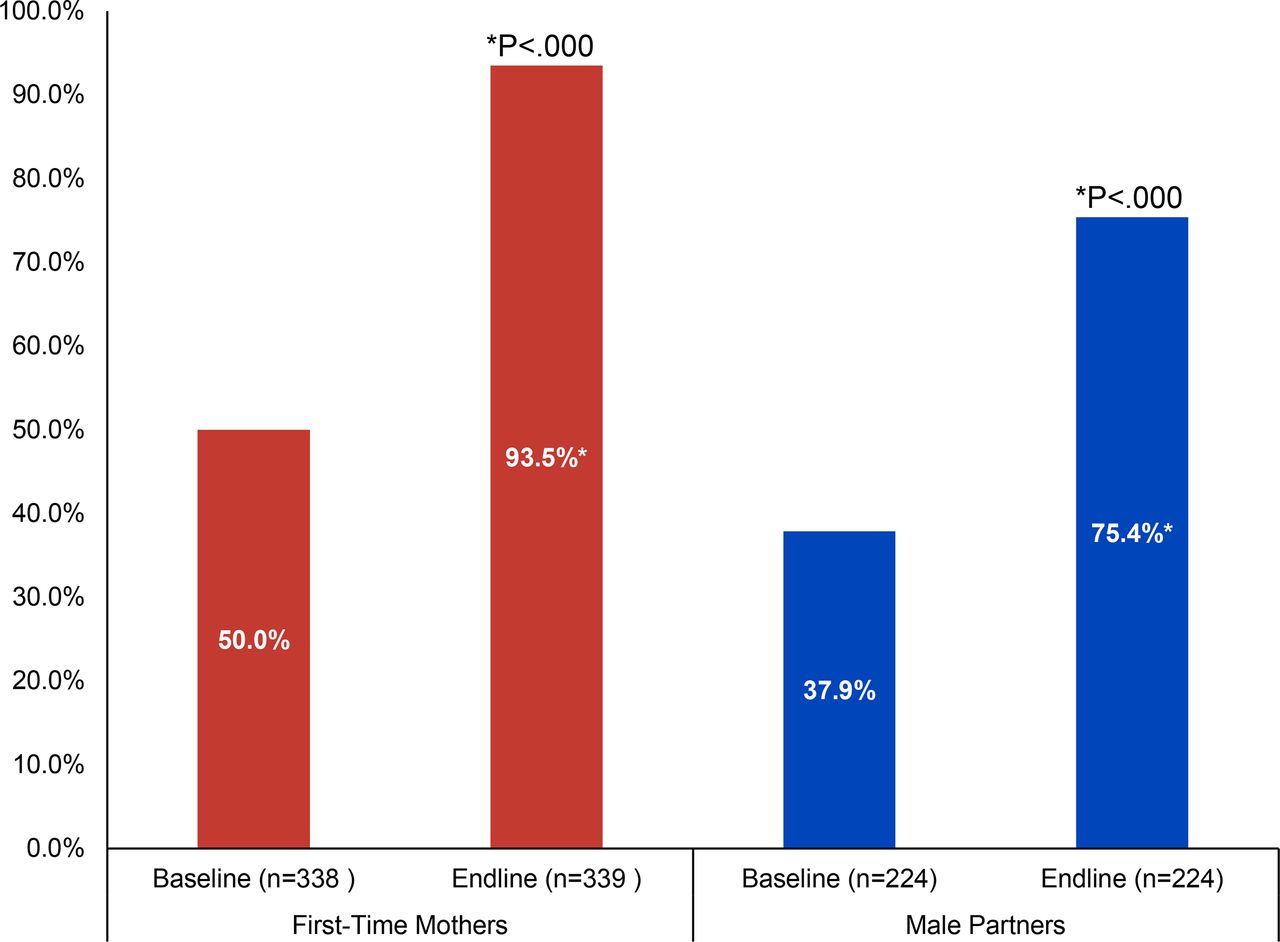
    FIGURE 1.

    Percentage of First-Time Parents Who Do Not Want Another Child or Who Wish to Wait 3 Years or Longer to Have Their Next Child, Cross River State, Nigeria

  • FIGURE 2.
    • Download figure
    • Open in new tab
    • Download powerpoint
    FIGURE 2.

    Percentage of First-Time Parents Who Can Name at Least 3 Modern Contraceptive Methods, Cross River State, Nigeria

  • FIGURE 3.
    • Download figure
    • Open in new tab
    • Download powerpoint
    FIGURE 3.

    Percentage of First-Time Parents Who Agree That Using Contraceptives May Negatively Affect One’s Ability to Have Children in the Future, Cross River State, Nigeria

  • FIGURE 4.
    • Download figure
    • Open in new tab
    • Download powerpoint
    FIGURE 4.

    Percentage of First-Time Parents Who Have Discussed Family Planning With Their Partner as a Way to Space Children in Past 3 Months, Cross River State, Nigeria

  • FIGURE 5.
    • Download figure
    • Open in new tab
    • Download powerpoint
    FIGURE 5.

    Current Use of a Modern Contraceptive Method (Among First-Time Parents Not Currently Pregnant), Cross River State, Nigeria

  • FIGURE 6.
    • Download figure
    • Open in new tab
    • Download powerpoint
    FIGURE 6.

    Current Modern Contraception Method Used Among First-Time Mothers Not Currently Pregnant (Multiple Responses Possible), Cross River State, Nigeria

    * P<.000.

    ** P<.01.

Tables

  • Figures
    • View popup
    TABLE 1.

    Criteria for Selection of Respondents and Achieved Sample Size Among Young First-Time Parents, Cross River State, Nigeria

    Selected ParticipantsBaselineEndline
    IkomObubraIkomObubra
    First-time mothers
    At least 10 FTM members were randomly sampled at both baseline and endline from each of the selected peer groups in both LGAs
    15 of 24 peer groups randomly selected at baseline; 150 FTMs randomly selected from each of the 15 groups17 of 26 peer groups randomly selected at baseline; 188 FTMs randomly selected from each of the 17 groupsThe same 15 peer groups selected at baseline were interviewed at endline; 149 FTMs randomly selected from each of the 15 groupsThe same 17 peer groups selected at baseline were interviewed at endline; 190 FTMs randomly selected from each of the 17 groups
    Male partners of FTMs
    All male partners participating in peer groups in both LGAs were selected for the study and interviewed
    All (census) 10 peer groups selected at baseline; all members of each group interviewed at baseline; 123 male partners interviewedAll (census) 10 peer groups selected at baseline; all members of each group interviewed at baseline; 122 male partners interviewedAll (census) 10 peer groups selected at baseline; all members of each group interviewed at endline; 114 male partners interviewedAll (census) 10 peer groups selected at baseline; all members of each group interviewed at endline; 111 male partners interviewed
    • Abbreviations: FTM, first-time mother; LGA, local government area.

    • View popup
    TABLE 2.

    Percentage Distribution of Age, Marital Status, Local Government Area, and Education Level by Participant Group and Baseline/Endline Among Young First-Time Parents, Cross River State, Nigeria

    First-Time MothersMale Partners
    Baseline (n=338)Endline (n=339)Baseline (n=224)Endline (n=224)
    Age, %
     15–19 years28.728.3a1.30.9
     20–24 years62.767.8a28.630.4
     25–29 years1.22.7a40.238.8
     30 years plus0.00.3a29.929.9
     Don’t know/missing7.40.9a0.00.0
     Mean age, years20.621.1b27.527.4
    Local government area, %
     Ikom44.444.050.950.9
     Obubra55.656.049.149.1
    Marital status, %
     Never married62.753.1b30.431.7
     Living with partner/married37.345.4b69.668.3
     Divorced/separated/widowed0.01.5b0.00.0
    No. of living children, %
     014.57.7b9.84.5
     185.592.0b85.390.2
     20.00.3b4.95.4
    Age of youngest child (among participants with at least 1 child)
     Mean age of youngest child (months)6.9 months (n=289)8.7a (n=312)8.8 months (n=199)10.9 months (n=214)
    Residential arrangement, %
     Currently lives with partner45.043.475.472.8
    Education level, %
     Primary13.910.93.64.0
     Junior Secondary (completed)35.236.69.810.3
     Secondary (completed)47.645.467.967.0
     Polytechnic1.82.94.03.1
     University1.54.114.715.6
    Works to earn money, %
     Yes36.156.9a84.886.6
    • ↵a Chi-square P<.000.

    • ↵b Chi-square P<.05.

    • View popup
    TABLE 3.

    Percentage Distribution of Partner Support for Family Planning by Participant Group and Baseline/Endline

    VariableFirst-Time MothersMale Partners
    Baseline, %(n=338)Endline, % (n=339)Baseline, % (n=224)Endline, % (n=224)
    Agrees that husband/partner would approve of using family planning to space next child66.979.6a90.693.8
    Would give wife/partner money to seek services if she wanted to use family planning to space her next birth87.993.8b
    • ↵a Chi-square P<.000.

    • ↵b McNemar’s test P<.05.

PreviousNext
Back to top

In this issue

Global Health: Science and Practice: 8 (4)
Global Health: Science and Practice
Vol. 8, No. 4
December 23, 2020
  • Table of Contents
  • About the Cover
  • Index by Author
  • Complete Issue (PDF)
Print
Download PDF
Article Alerts
Sign In to Email Alerts with your Email Address
Email Article

Thank you for your interest in spreading the word about Global Health: Science and Practice.

NOTE: We only request your email address so that the person you are recommending the page to knows that you wanted them to see it, and that it is not junk mail. We do not capture any email address.

Enter multiple addresses on separate lines or separate them with commas.
Effects of a Community-Based Program on Voluntary Modern Contraceptive Uptake Among Young First-Time Parents in Cross River State, Nigeria
(Your Name) has forwarded a page to you from Global Health: Science and Practice
(Your Name) thought you would like to see this page from the Global Health: Science and Practice web site.
CAPTCHA
This question is for testing whether or not you are a human visitor and to prevent automated spam submissions.
Citation Tools
Effects of a Community-Based Program on Voluntary Modern Contraceptive Uptake Among Young First-Time Parents in Cross River State, Nigeria
Gwendolyn Morgan, Anjala Kanesathasan, Akinsewa Akiode
Global Health: Science and Practice Dec 2020, 8 (4) 783-798; DOI: 10.9745/GHSP-D-20-00111

Citation Manager Formats

  • BibTeX
  • Bookends
  • EasyBib
  • EndNote (tagged)
  • EndNote 8 (xml)
  • Medlars
  • Mendeley
  • Papers
  • RefWorks Tagged
  • Ref Manager
  • RIS
  • Zotero
Share
Effects of a Community-Based Program on Voluntary Modern Contraceptive Uptake Among Young First-Time Parents in Cross River State, Nigeria
Gwendolyn Morgan, Anjala Kanesathasan, Akinsewa Akiode
Global Health: Science and Practice Dec 2020, 8 (4) 783-798; DOI: 10.9745/GHSP-D-20-00111
del.icio.us logo Twitter logo Facebook logo Mendeley logo
  • Tweet Widget
  • Facebook Like
  • Google Plus One

Statistics from Altmetric.com

Jump to section

  • Article
    • ABSTRACT
    • INTRODUCTION
    • PROGRAM DESCRIPTION
    • METHODOLOGY
    • RESULTS
    • DISCUSSION
    • CONCLUSION
    • Acknowledgments
    • Notes
    • REFERENCES
  • Figures & Tables
  • Info & Metrics
  • Comments
  • PDF

Related Articles

  • No related articles found.
  • PubMed
  • Google Scholar

Cited By...

  • Designing for Impact and Institutionalization: Applying Systems Thinking to Sustainable Postpartum Family Planning Approaches for First-Time Mothers in Bangladesh
  • Google Scholar

More in this TOC Section

  • Uganda Public Health Fellowship Program’s Contributions to Malaria Control Programs 2015–2022: Strategies, Implementation Challenges, and Opportunities
  • A Comprehensive Strategy to Mitigate Institutional Maternal Mortality: Lessons From a Quality Improvement Initiative in Brazilian Maternity Hospitals
  • Research and Learning Priorities for a Surgical Obstetrics and Family Planning Project Implementing in Low- and Middle-Income Countries: Results of an Expert Consultation
Show more ORIGINAL ARTICLE

Similar Articles

Subjects

  • Health Topics
    • Family Planning and Reproductive Health
  • Cross-Cutting Topics
    • Gender
Johns Hopkins Center for Communication Programs

Follow Us On

  • LinkedIn
  • Facebook
  • RSS

Articles

  • Current Issue
  • Advance Access Articles
  • Past Issues
  • Topic Collections
  • Most Read Articles
  • Supplements

More Information

  • Submit a Paper
  • Instructions for Authors
  • Instructions for Reviewers

About

  • About GHSP
  • Advisory Board
  • FAQs
  • Privacy Policy
  • Contact Us

© 2026 Creative Commons Attribution 4.0 International License. ISSN: 2169-575X

Powered by HighWire