

Figures & Tables
Figures
Delegates in the South-East Asia (SEARO) and Western Pacific (WPRO) committee in moderated caucus.
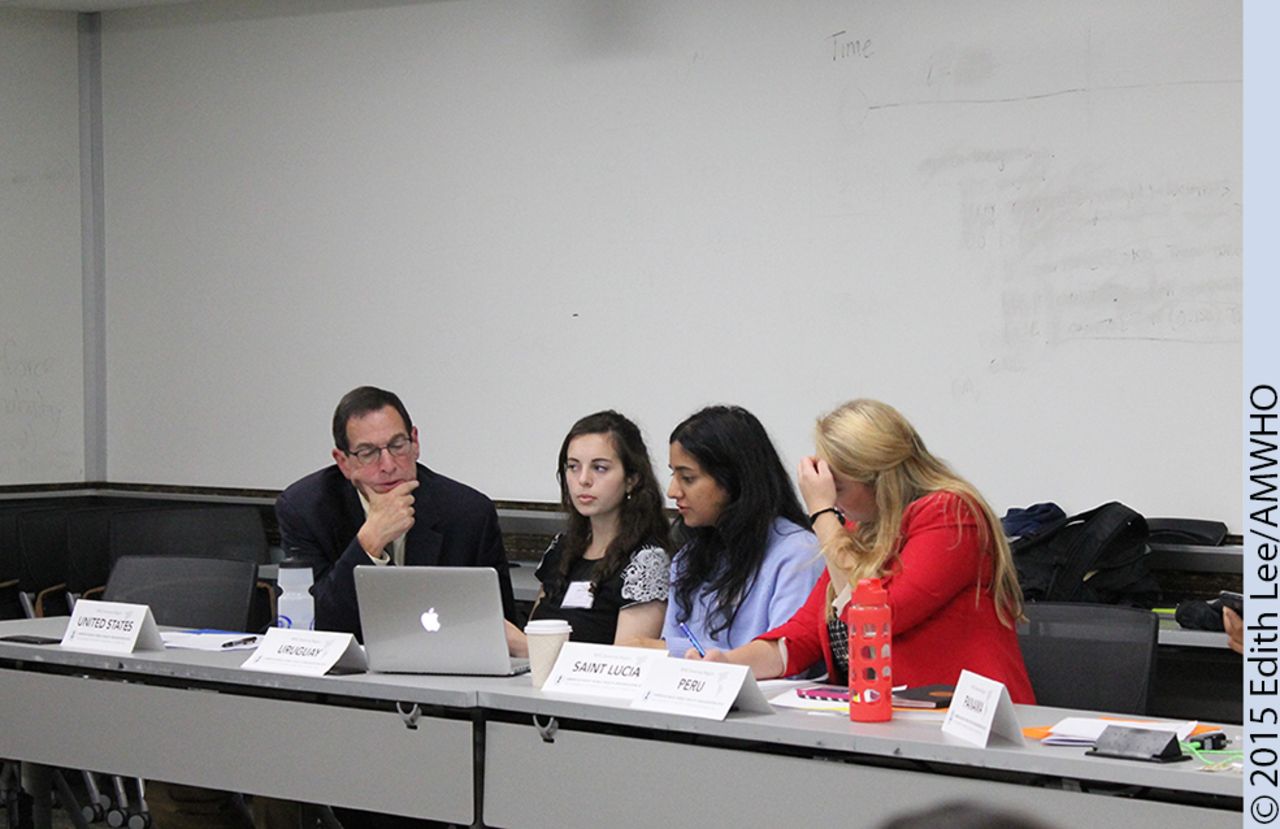
U.S. Ambassador Jimmy Kolker, Assistant Secretary for Global Affairs at the U.S. Department of Health and Human Services and the U.S. representative to the WHO, works with students on a resolution at the American Mock World Health Organization 2015 conference.

Tables
Day and Time Program Friday 1:00–1:45 pm Delegate Training 1:45–3:00 pm Opening Ceremonies 3:00–6:00 pm Committee 1 6:00–7:00 pm Speaker 1 7:00–9:00 pm Delegate Dinner Saturday 8:30–9:00 am Breakfast 9:00 am–12:00 pm Committee 2 12:00–2:00 pm Lunch & Learn 2:00–4:00 pm Committee 3 4:00–5:00 pm Speaker 2 5:00–7:00 pm Committee 4 7:30–9:00 pm Delegate Social Sunday 8:30–9:00 am Breakfast 9:00 am–12:00 pm Plenary 1 12:00–1:15 pm Lunch 1:15–2:15 pm Plenary 2 2:15–3:30 pm Keynote Speaker 3:30–4:30 pm Plenary 3 4:30–5:15 pm Closing Ceremonies - TABLE 2.
Speakers at the American Mock World Health Organization 2014 and 2015 Conferences
Year Day 1 Day 2 Day 3 2014 Steven Wayling: former technical officer with the Global Programme on AIDS in the WHO/EURO office in Copenhagen Heather Davis: worked with PEPFAR and CARE in Ethiopia and the DRC Mory Pagel: worked with SIT Study Abroad on field-based research within the WHO in Geneva, Switzerland 2015 Dr. Audrey R. Chapman: professor in the Division of Public Health Law and Bioethics, and the first Healey Endowed Chair in Medical Ethics and Humanities at the University of Connecticut Health Center Dr. Timothy G. Maestro: Director of Global Health, Population and Nutrition at FHI 360 U.S. Ambassador Jimmy Kolker: Assistant Secretary for Global Affairs at the U.S. Department of Health and Human Services and the U.S. representative to the WHO under President Barack Obama Abbreviations: DRC, Democratic Republic of the Congo; PEPFAR, The United States President's Emergency Plan for AIDS Relief; SIT, School for International Training; WHO/EURO, World Health Organization Regional Office for Europe.
University Represented at AMWHO 2014 and/or 2015 Chapter Organization Regional Conference Host University of North Carolina at Chapel Hill ✓ ✓ ✓ Emory University ✓ ✓ ✓ Virginia Tech ✓ ✓ ✓ University of Kentucky ✓ ✓ ✓ University of South Carolina ✓ ✓ Mercer University ✓ ✓ University of Georgia ✓ ✓ ✓ University of Denver ✓ ✓ Cornell University ✓ ✓ ✓ University of Washington ✓ ✓ ✓ Johns Hopkins Bloomberg School of Public Health ✓ ✓ Case Western Reserve University ✓ ✓ …and 21 more universities ✓ Abbreviation: AMWHO, American Mock World Health Organization.
- TABLE 4.
Determination of Resolution Topics at the American Mock World Health Organization 2015 Conference, by Region/Committee
Region Proposed Subthemes Selected Subtheme (Agenda) Resolution Title Resolution Topics African Region (AFRO) Sustainable health systems
Diverse funding sources for health care
Teaching, managing, and organizing community health workers
Health education reform
Novel measurement and evaluation methods for health interventions
Emphasis on incorporating social determinants of health in health policy aimed at universal health coverage
Creating sustainable health systems in all African nations and achieving universal health coverage by holistically innovating health care infrastructure to meet nation-specific needs The creation of sustainable health systems Retention, education, and training of a competent health care workforce
Methods to improve health education to educate different communities and demographics
Strengthening relationships between nations and NGOs
Creation of a novel framework to create and develop sustainable health systems
Addressing the health care needs of refugees
Americas Region (AMRO) Primary care accessibility
Definition of essential medicines
Health outcomes measurement
Health financing
Health workforce and resources
Vulnerable and neglected populations
Ensuring universal health coverage as defined by equitable access to health services for all, with an emphasis on access to care for vulnerable populations. Ensuring universal health coverage as defined by equitable access to health services for all, emphasizing access to care for vulnerable populations Health information systems integration
Definition of essential medicines
Financial support
Service expansion and sustainable development
Appropriate training of community health workers
Eastern Mediterranean Region (EMRO) Community health worker training and curriculum development
Supportive health care units during times of crisis
Training primary health care doctors for both practice and retention in EMRO
Designing and implementing a crisis package for universal health coverage in conflicts areas
Universal policy to guarantee security and sustainability during times of natural and welfare crisis
Package that focuses on data analysis and primary health care delivery to target populations, encourages the increase of sanitation and water access across EMRO, sets aside a crisis fund, and improves medical education to train and retain primary health care doctors during times of crisis
Implementing universal health coverage including building the framework for health analytics, crisis funding, primary health care funding, education of medical professionals, and security within health care infrastructures Immediate Relief Universal Health Care Package for Times of Crisis Provision of immediate relief resources
Establishment of an EMRO crisis fund
Creation of longitudinal health care approaches
Developing partnerships between governments and centers of excellence
European Region (EURO) Education of health care workforce to address quantity and specialization of health care providers
Access to health care services for vulnerable populations
Bolstering preventative care to increase health care efficiency
Privatization of universal health care for health financing
Surveillance and sustainability of health care workforce
Addressing accessibility and availability of health care workforce as a means of providing universal health coverage with a focus on outreach to vulnerable populations Increase the number, training, quality, and equitable distribution of workforce Restructuring of health care education
Redistribution of health care workforce
Financial sustainability and surveillance of novel educational programs
South-East Asian Region and Western Pacific Region (SEARO/WPRO)a Quality of service
Equal and affordable access
Rural access
Emergency services
Financing universal health coverage
Financing universal health care with a focus on improving service quality and decreasing health inequality Financial Support for SEARO/WPRO Health Initiatives Creation of a regional financial management committee to manage and administer funds
Cost-sharing for NGOs and governments
Decentralized programs
Monitoring and assessment of efficient fund allocation
↵a For the purposes of creating similar-sized committees, SEARO and WPRO, the 2 smallest regions of the WHO, were combined for all AMWHO conferences.
- TABLE 5.
Feedback About the American Mock World Health Organization (AMWHO) Conferences: Qualitative Findings From Survey Respondents
AMWHO Objectives Relevant Qualitative Survey Findings Student engagement in global health diplomacy Delegates noted that "AMWHO 2014 was a truly unique event; tackling international issues in healthcare by engaging in constructive debates and drafting resolutions allowed us to think critically about … solutions to promote health worldwide" and was "an ingenious way to engage students from various disciplines through interactive and self-guided learning." Guidance to future directions One delegate reflected, "Coming with very little experience in the global public health arena, AMWHO has allowed me to figure out where my purpose is: at the intersection of public policy and public health. I truly give AMWHO significant credit for giving me clarity regarding my future plans."
Another attendee said, "[AMWHO] revived my passion for diplomacy and advocacy. This was the first time I saw that my dream could actually be realized and that my potential and the possibilities are endless."Putting theory and knowledge into practice Several students commented on the practical nature of the conference. For example, 1 participant observed, "I learned that the intricacies and difficulties of forming global health policy are not something you can really learn in a lecture. The kinds of experiences provided at AMWHO allowed a paradigm shift not possible in class." Understanding other perspectives One student remarked, "AMWHO is a unique opportunity because we learn to think in the perspectives of policymakers, which helps us understand the difficulties involved with it. As future public health leaders, it's important to understand why nations or parties support or deny certain policies. If we can understand someone's perspectives, only then can we begin to cooperate with him/her to create more comprehensive solutions to our world's greatest problems." Introducing diplomacy and global health skills One student noted, "As a scientist, it is important for me to understand how health policy is made since it both influences and is influenced by scientific research. Because of AMWHO I feel much better prepared to be an active participant in bridging the gap between research and global health."
In this issue


Statistics from Altmetric.com
Jump to section
Related Articles
Cited By...
- No citing articles found.