Main menu

  • Content
    • Current Issue
    • Advance Access
    • Archive
    • Supplements
    • Special Collections
    • Topic Collections
  • For Authors
    • Instructions for Authors
    • Tips for Writing About Programs in GHSP
      • Local Voices Webinar
      • Connecting Creators and Users of Knowledge
    • Submit Manuscript
    • Publish a Supplement
    • Promote Your Article
    • Resources for Writing Journal Articles
  • About
    • About GHSP
    • Editorial Team
    • Advisory Board
    • FAQs
    • Instructions for Reviewers

User menu

  • My Alerts

Search

  • Advanced search
Global Health: Science and Practice
  • My Alerts

Global Health: Science and Practice

Dedicated to what works in global health programs

Advanced Search

  • Content
    • Current Issue
    • Advance Access
    • Archive
    • Supplements
    • Special Collections
    • Topic Collections
  • For Authors
    • Instructions for Authors
    • Tips for Writing About Programs in GHSP
    • Submit Manuscript
    • Publish a Supplement
    • Promote Your Article
    • Resources for Writing Journal Articles
  • About
    • About GHSP
    • Editorial Team
    • Advisory Board
    • FAQs
    • Instructions for Reviewers
  • Alerts
  • Find GHSP on LinkedIn
  • Visit GHSP on Facebook
  • RSS
ORIGINAL ARTICLE
Open Access

Factors Associated With Community Health Worker Performance Differ by Task in a Multi-Tasked Setting in Rural Zimbabwe

Rukundo A Kambarami, Mduduzi NN Mbuya, David Pelletier, Dadirai Fundira, Naume V Tavengwa and Rebecca J Stoltzfus
Global Health: Science and Practice June 2016, 4(2):238-250; https://doi.org/10.9745/GHSP-D-16-00003
Rukundo A Kambarami
aCornell University, Division of Nutritional Sciences, Program in International Nutrition, Ithaca, NY, USA
  • Find this author on Google Scholar
  • Find this author on PubMed
  • Search for this author on this site
Mduduzi NN Mbuya
aCornell University, Division of Nutritional Sciences, Program in International Nutrition, Ithaca, NY, USA
bZvitambo Institute for Maternal and Child Health Research, Harare, Zimbabwe
  • Find this author on Google Scholar
  • Find this author on PubMed
  • Search for this author on this site
David Pelletier
aCornell University, Division of Nutritional Sciences, Program in International Nutrition, Ithaca, NY, USA
  • Find this author on Google Scholar
  • Find this author on PubMed
  • Search for this author on this site
Dadirai Fundira
aCornell University, Division of Nutritional Sciences, Program in International Nutrition, Ithaca, NY, USA
  • Find this author on Google Scholar
  • Find this author on PubMed
  • Search for this author on this site
Naume V Tavengwa
bZvitambo Institute for Maternal and Child Health Research, Harare, Zimbabwe
  • Find this author on Google Scholar
  • Find this author on PubMed
  • Search for this author on this site
Rebecca J Stoltzfus
aCornell University, Division of Nutritional Sciences, Program in International Nutrition, Ithaca, NY, USA
  • Find this author on Google Scholar
  • Find this author on PubMed
  • Search for this author on this site
PreviousNext
  • Article
  • Figures & Tables
  • Supplements
  • Info & Metrics
  • Comments
  • PDF
Loading

Figures & Tables

Figures

  • Tables
  • Additional Files
  • FIGURE
    • Download figure
    • Open in new tab
    • Download powerpoint
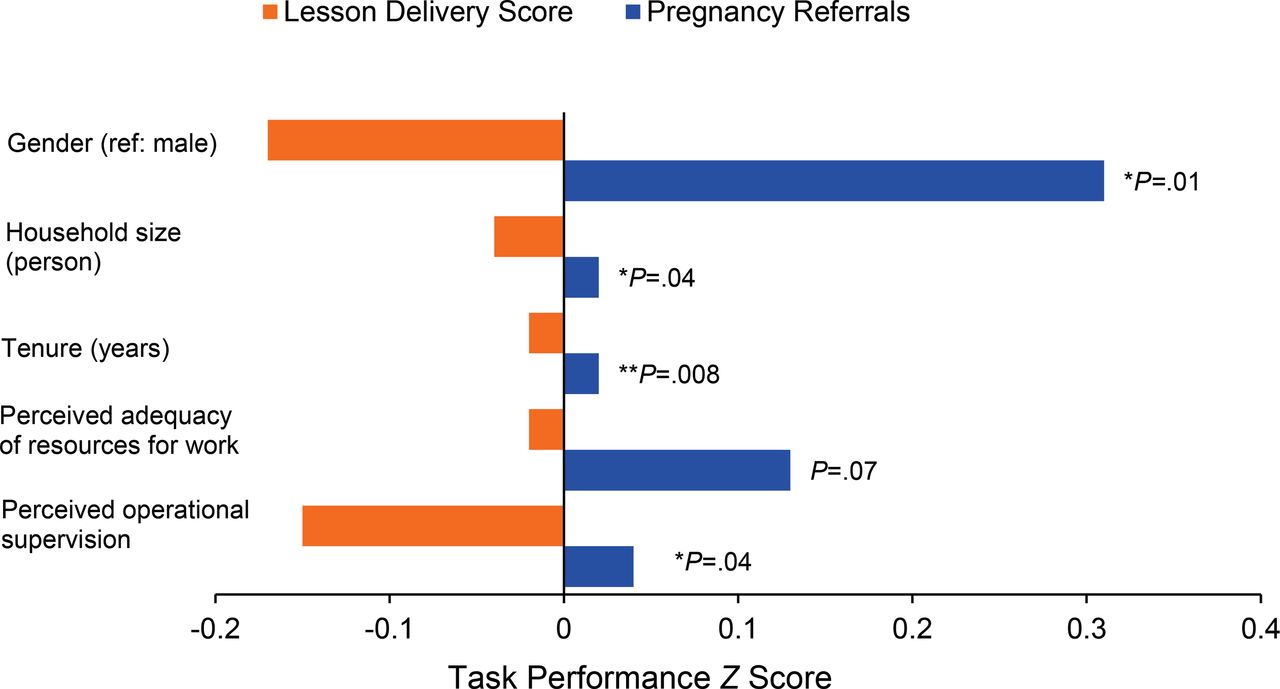
    FIGURE

    Significant Interaction Terms of Task and Demographic and Work Characteristics From the Interaction Model, Shurugwi and Chirumanzu Districts, Zimbabwe, 2013

Tables

  • Figures
  • Additional Files
    • View popup
    TABLE 1 Background Characteristics of Community Health Workers, Shurugwi and Chirumanzu Districts, Zimbabwe, 2013 (N = 322)
    CharacteristicValue
    Age, mean ± SD, years45.0 ± 8.8
     <40, No. (%)87 (27.0)
     40–50, No. (%)153 (47.5)
     >50, No. (%)82 (25.5)
    Gender, No. (%)
     Female237 (73.6)
    Marital status, No. (%)
     Currently married247 (76.7)
     Other75 (23.3)
    Household size, mean ± SD4.82 ± 2.50
    Educational level, No. (%)
     Primary (7 years)54 (16.8)
     Some secondary (8–10 years)101 (31.4)
     “O” Levela or higher (11+ years)167 (51.9)
    Tenure as CHW, median (IQR), years3.2 (2.2, 11.1)
    First experience with health education job, No (%)243 (75.5)
    • Abbreviations: IQR, interquartile range; SD, standard deviation; CHW, community health worker.

    • a Ordinary, or “O”, Level certificate examination is a terminal examination taken after 4 years of secondary education.

    • View popup
    TABLE 2 Description of 8 Work Characteristic Factors Emerging From Factor Analysis of CHW Survey Responses, Shurugwi and Chirumanzu Districts, Zimbabwe, 2013
    FactorNumber of Survey ItemsDescription of Factor
    Perceived job satisfaction and intrinsic motivation12Feels personally motivated and happy with work and making a positive impact; feels appreciated by community, health workers, and organization for work
    Satisfaction with remuneration3Satisfied with remuneration for the work
    Perceived peer support5Receives advice and support from other CHWs
    Perceived supportive supervision12Feels valued, motivated, guided, and heard, and feels supervisor is accessible
    Perceived operational supervision10Feels informed and consulted about work activities; received communication to improve work; feels needs are represented
    Perceived adequacy of resources for work5Frequency of shortage of transportation and work tools
    Perceived negative performance feedback5Community, other CHWs, and supervisor attitude indicate poor performance
    Perceived positive performance feedback6Supervisor and community inform CHW of good performance, positive changes in community; increased job confidence
    • Abbreviation: CHW, community health worker.

    • View popup
    TABLE 3 Reliability of Scales Assessing CHW Work Characteristic Survey Questions, Shurugwi and Chirumanzu Districts, Zimbabwe, 2013
    Work Characteristic (Range of Scale) (No. of Respondents)Cronbach alphaRange in DataMean ± SD
    Health curriculum knowledge (1–24) (N = 322)–a11–2217.6±2.0
    Job satisfaction and motivation (12–60) (N = 311)0.8539–6053.0±4.7
    Satisfaction with remuneration (3–15) (N = 318)0.923–159.9±3.4
    Perceived peer support (5–25) (N = 316)0.755–2518.7±4.4
    Perceived supportive supervision (12–60) (N = 314)0.9031–6051.7±5.7
    Perceived operational supervision (10–50) (N = 310)0.7722–5042.6±5.7
    Perceived negative feedback (5–25) (N = 307)0.727–2517.6±3.6
    Perceived positive feedback (6–30) (N = 315)0.6816–3025.3±2.5
    Perceived adequacy of resources for work (5–25) (N = 312)0.705–2515.7±4.3
    • Abbreviations: CHW, community health worker; SD, standard deviation.

    • ↵a Knowledge items were based on training materials and do not reflect a singular “knowledge” construct; therefore, we do not report a Cronbach alpha.

    • View popup
    TABLE 4 Poisson Regression Models to Predict Factors Associated With the Pregnancy Referral Rate (in 1 Year) of CHWs, Shurugwi and Chirumanzu Districts, Zimbabwe, 2013
    CHW VariablesPregnancy Referral Rate
    Complete-Case Model (N = 299)Imputed Model (N = 319)
    IRR (95% CI)P ValueIRR (95% CI)P Value
    Age, years (reference: <40)
     40–490.89 (0.80, 0.99).04*0.89 (0.80, 0.98).02*
     ≥500.81 (0.70, 0.93).002**0.81 (0.71, 0.93).002**
    Gender (reference: male)1.14 (1.02, 1.26).02*1.13 (1.02, 1.25).02*
    Marital status (reference: not married)0.89 (0.80, 0.98).02*0.88 (0.80, 0.97).01*
    Household size1.02 (1.00, 1.03).071.01 (1.00, 1.03).047*
    Tenure, years1.01 (1.00, 1.02).003**1.01 (1.00, 1.02).003**
    Satisfaction with remuneration0.92 (0.87, 0.96)<.001***0.92 (0.88, 0.96)<.001***
    Perceived adequacy of resources for work1.06 (1.02, 1.11).008**1.06 (1.02, 1.11).006**
    Perceived positive feedback1.06 (1.01, 1.11).01*1.06 (1.01, 1.10).01*
    • Abbreviations: CI, confidence interval; IRR, incidence rate ratio; CHW, community health worker.

    • Models adjusted for CHWs’ education, knowledge, study arm, cluster ID, ward number, and median number of women of childbearing age per CHW catchment area.

    • Significant at

    • ↵* P<.05;

    • ↵** P<.01;

    • *** P<.001.

    • View popup
    TABLE 5 Multiple Linear Regression Models to Predict Factors Associated With Behavior Change Lesson Delivery Scoresa of CHWs, Shurugwi and Chirumanzu Districts, Zimbabwe, 2013
    CHW VariablesLesson Delivery Score
    Complete-Case Model (N = 274)Imputed Model (N = 289)a
    Beta (SE)P ValueBeta (SE)P Value
    Household size-0.14 (0.08).05-0.12 (0.07).08
    Tenure, years-0.05 (0.03).13-0.05 (0.04).11
    Perceived supportive supervision0.43 (0.21).04*0.41 (0.20).04*
    Perceived operational supervision-0.45 (0.21).03*-0.43 (0.20).04*
    • Abbreviations: CHW, community health worker; SE, standard error.

    • a Based on supervisor’s summative score to six 5-point Likert response statements: reviewed last session with mother; asked mother questions about her recall, knowledge, and current practices; delivered lesson in a relaxed manner; allowed mother to ask questions; responded to mother’s questions correctly and appropriately; and reviewed current lesson information at the end of the session.

    • Models adjusted for age, gender, marital status, education, knowledge, study arm, cluster ID, ward number, and number of observations per CHW.

    • Significant at

    • * P<.05

    • ↵** P<.01;

    • *** P<.001.

Additional Files

  • Figures
  • Tables
  • GHSP-D-16-00003 Supplementary Table

    Kambarami et al. doi: 10.9745/GHSP-D-16-00003

    • Supplementary Table 1 - Kambarami et al. doi: 10.9745/GHSP-D-16-00003
    • Supplementary Table 2 - Kambarami et al. doi: 10.9745/GHSP-D-16-00003
PreviousNext
Back to top

In this issue

Global Health: Science and Practice: 4 (2)
Global Health: Science and Practice
Vol. 4, No. 2
June 20, 2016
  • Table of Contents
  • About the Cover
  • Index by Author
  • Complete Issue (PDF)
Print
Download PDF
Article Alerts
Sign In to Email Alerts with your Email Address
Email Article

Thank you for your interest in spreading the word about Global Health: Science and Practice.

NOTE: We only request your email address so that the person you are recommending the page to knows that you wanted them to see it, and that it is not junk mail. We do not capture any email address.

Enter multiple addresses on separate lines or separate them with commas.
Factors Associated With Community Health Worker Performance Differ by Task in a Multi-Tasked Setting in Rural Zimbabwe
(Your Name) has forwarded a page to you from Global Health: Science and Practice
(Your Name) thought you would like to see this page from the Global Health: Science and Practice web site.
CAPTCHA
This question is for testing whether or not you are a human visitor and to prevent automated spam submissions.
Citation Tools
Factors Associated With Community Health Worker Performance Differ by Task in a Multi-Tasked Setting in Rural Zimbabwe
Rukundo A Kambarami, Mduduzi NN Mbuya, David Pelletier, Dadirai Fundira, Naume V Tavengwa, Rebecca J Stoltzfus
Global Health: Science and Practice Jun 2016, 4 (2) 238-250; DOI: 10.9745/GHSP-D-16-00003

Citation Manager Formats

  • BibTeX
  • Bookends
  • EasyBib
  • EndNote (tagged)
  • EndNote 8 (xml)
  • Medlars
  • Mendeley
  • Papers
  • RefWorks Tagged
  • Ref Manager
  • RIS
  • Zotero
Share
Factors Associated With Community Health Worker Performance Differ by Task in a Multi-Tasked Setting in Rural Zimbabwe
Rukundo A Kambarami, Mduduzi NN Mbuya, David Pelletier, Dadirai Fundira, Naume V Tavengwa, Rebecca J Stoltzfus
Global Health: Science and Practice Jun 2016, 4 (2) 238-250; DOI: 10.9745/GHSP-D-16-00003
del.icio.us logo Twitter logo Facebook logo Mendeley logo
  • Tweet Widget
  • Facebook Like
  • Google Plus One

Statistics from Altmetric.com

Jump to section

  • Article
    • ABSTRACT
    • INTRODUCTION
    • METHODS
    • RESULTS
    • DISCUSSION
    • CONCLUSION
    • Acknowledgments
    • Notes
    • REFERENCES
  • Figures & Tables
  • Supplements
  • Info & Metrics
  • Comments
  • PDF

Related Articles

  • PubMed
  • Google Scholar

Cited By...

  • No citing articles found.
  • Google Scholar

More in this TOC Section

  • Patterns and Drivers of Packaged (Fortified) Maize Flour Purchase in Urban and Peri-Urban Kenya
  • Exploring a Road Map to Achieving Tobacco Endgame in sub-Saharan Africa: A Qualitative Study Among Stakeholders From 12 Countries
  • Stakeholder Perceptions on Innovative Private Pharmacy Distribution Channels and Implications for Medicine Quality in Zambia: A Qualitative Study
Show more ORIGINAL ARTICLE

Similar Articles

Subjects

  • Cross-Cutting Topics
    • Health Workers
  • Health Topics
    • Maternal, Newborn, and Child Health
Johns Hopkins Center for Communication Programs

Follow Us On

  • LinkedIn
  • Facebook
  • RSS

Articles

  • Current Issue
  • Advance Access Articles
  • Past Issues
  • Topic Collections
  • Most Read Articles
  • Supplements

More Information

  • Submit a Paper
  • Instructions for Authors
  • Instructions for Reviewers

About

  • About GHSP
  • Advisory Board
  • FAQs
  • Privacy Policy
  • Contact Us

© 2026 Creative Commons Attribution 4.0 International License. ISSN: 2169-575X

Powered by HighWire