

Figures & Tables
Figures
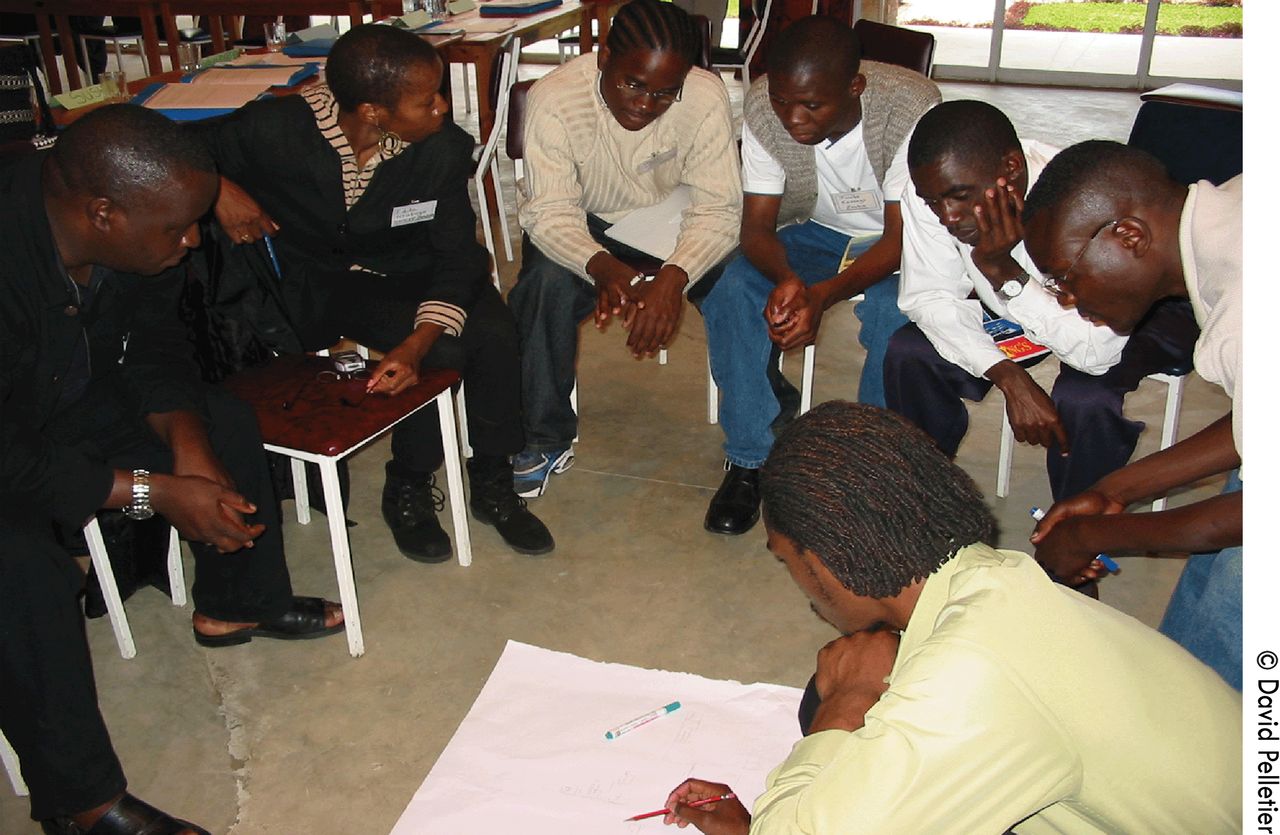
Participants in Mali analyze data on infant and young child feeding practices during a community diagnosis. Such participatory and action‐oriented research methods tend to examine health problems in a broader context and involve community actors in the research process itself.
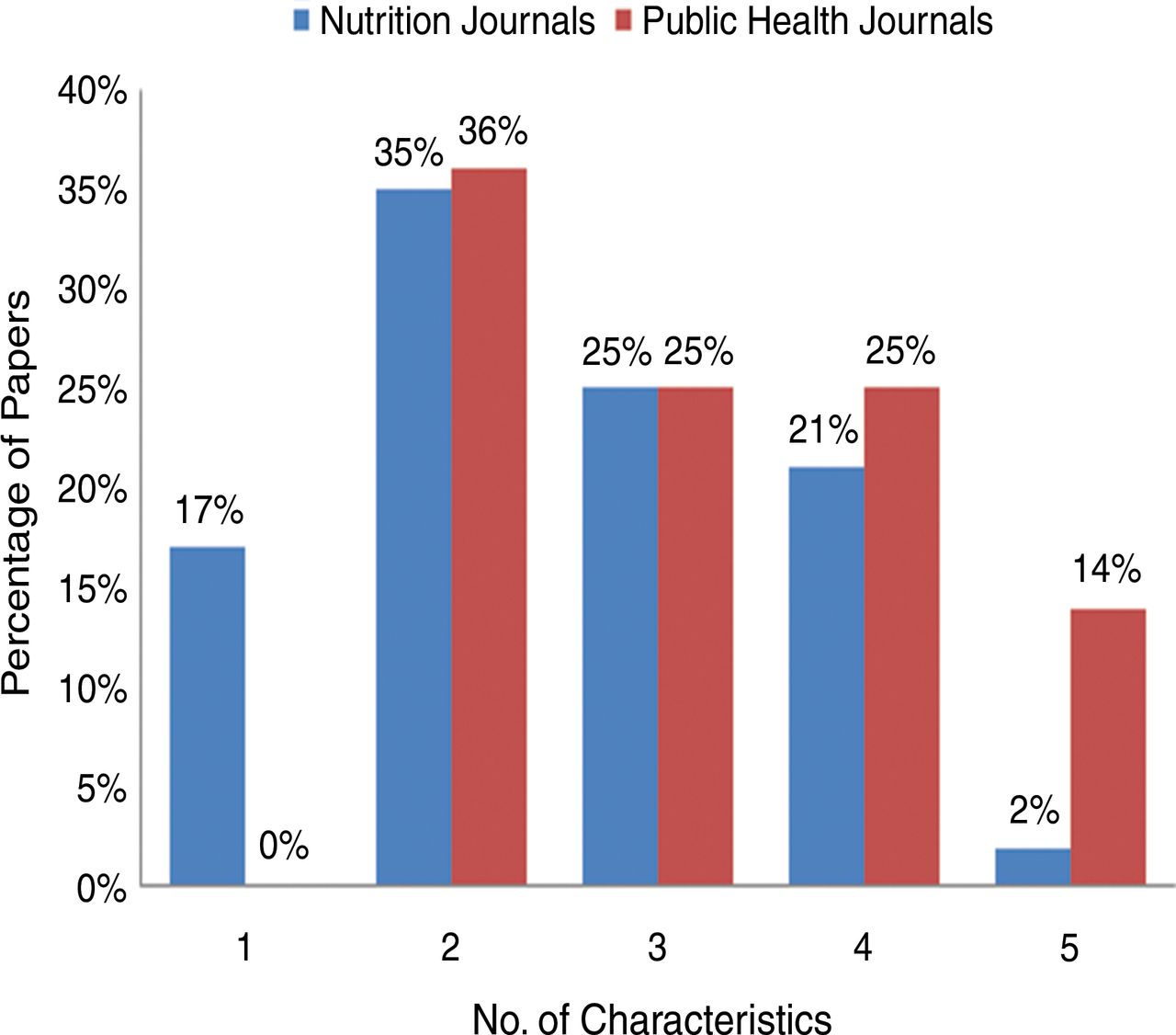
- FIGURE.
Number of Action‐Oriented Research Characteristics in Nutrition Papers by Journal Type (N=80)
In Ghana, a group of young men map factors and locations in their community that place youth at risk for HIV. This type of youth action research trains young people in the research process, including using their findings to inform direct change in their communities.

Tables
Dimension Conventional Research Action-Oriented Research Why we study To create generalizable or fundamental knowledge that answers scientific questions To create knowledge that can help identify, characterize, and solve practical problems of concern to stakeholders, organizations, communities, or publics at various scales What we study (topics) Nutrients, food and nutrient intake, consumer behavior, determinants and consequences of nutritional variation, efficacy of interventions Food and nutrition issues, causes, and solutions in a broader social and action context, including food systems, social and public health programs and policies; processes of policy agenda setting, governance, development, implementation, scaling-up, and evaluation; and community and organizational behavior and change processes Who we study (actors) Mothers, infants, children, individuals, consumers, patients Policy makers, analysts, managers, implementers, frontline workers in the public sector; global, national, state, and local leaders and members of communities, civil society organizations, universities, networks, and coalitions; global, national, state, and local private-sector actors and entities, citizens, academics How we study: methods Measurements of knowledge, attitudes, beliefs, behavior, biology, individual and environmental characteristics, and their interrelationships, using a limited range of quantitative and qualitative methods More eclectic range of qualitative and quantitative methods to inquire into the new topics noted above, including mixed methods, social network analysis, discourse analysis, narrative policy analysis, Q methodology, process tracing, stakeholder analysis and influence mapping, program impact pathways, organizational ethnography, systems dynamics group modeling How we study: approaches Generally detached, objectivist, positivist, reductionist, behaviorist, hypothesis testing More engaged, participatory, action research, community-based participatory research, participant-observer, reflection in action, embedded, critical, social construction, emergent, systems- and complexity-oriented Disciplinary foundations Nutritional sciences, epidemiology and biostatistics, biomedicine, psychology, social psychology, consumer behavior Transdisciplinary, drawing upon our traditional disciplines but also with a greater role for economics, sociology, anthropology, policy analysis, law, urban planning, political science, organizational behavior, management sciences, and systems sciences ↵a In many cases, the distinctions shown in this table are a matter of degree or emphasis rather than discrete categories. Individual studies or research programs may possess many or few of these characteristics, to a greater or lesser extent.
Reprinted and adapted with permission from Pelletier et al., 2013 in Advances in Nutrition.26 Copyright 2013 by American Society for Nutrition.
- TABLE 2. Nutrition-Focused Papers With Action-Oriented Research Characteristics Published in 2012 in Nutrition and Public Health Journals
Journal Name Total No. of Nutrition Papers in 2012 No. (%) of Papers With ≥1 Action-Oriented Characteristica No. (%) of Papers per Action-Oriented Characteristicb Topic(s) of study Processes/ Influences Actors Methods Approach Nutrition Journals Ecology of Food and Nutrition 19 4 (21.1) 3 (75.0) 4 (100.0) 1 (25.0) 2 (50.0) 2 (50.0) Journal of Nutrition Education and Behavior 90 13 (14.4) 6 (46.2) 11 (84.6) 6 (46.2) 3 (23.1) 4 (30.8) Maternal and Child Nutrition 47 5 (10.6) 5 (100.0) 4 (80.0) 5 (100.0) 2 (40.0) 3 (60.0) Journal of Nutrition 308 7 (2.3) 6 (85.7) 5 (71.4) 1 (14.3) 0 (0.0) 0 (0.0) Public Health Nutrition 252 22 (8.7) 15 (68.2) 17 (77.3) 9 (40.9) 9 (40.9) 7 (31.8) International Journal of Behavioral Nutrition and Physical Activity 46 1 (2.2) 1 (100.0) 1 (100.0) 1 (100.0) 0 (0.0) 0 (0.0) Subtotal 762 52 (6.8) 36 (69.2) 42 (80.8) 23 (44.2) 16 (30.8) 16 (30.8) Public Health Journals American Journal of Public Health 24 8 (33.3) 8 (100.0) 7 (87.5) 3 (37.5) 4 (50.0) 0 (0.0) Health Policy and Planning 4 4 (100.0) 4 (100.0) 4 (100.0) 2 (50.0) 4 (100.0) 3 (75.0) Social Science & Medicine 26 7 (26.9) 7 (100.0) 5 (71.4) 3 (42.9) 4 (57.1) 3 (42.9) Journal of School Health 23 9 (39.1) 9 (100.0) 9 (100.0) 4 (44.4) 4 (44.4) 2 (22.2) Subtotal 77 28 (36.4) 28 (100.0) 25 (89.3) 12 (42.9) 16 (57.1) 8 (28.9) TOTAL 839 80 (9.5) 64 (80.0) 67 (83.8) 35 (43.8) 32 (40.0) 24 (30.0) - TABLE 3. Illustrations of Action-Oriented Research Characteristics of “Topic(s) of Study” and “Processes/Influences” in Nutrition Journals
Key Topics Topic(s) of Study Processes/Influences National policy US, Ireland, UK, dietary guidelines, growth charts, nutrition in child-care settings, revision process, development process, communications initiatives Translation at local/regional levels, barriers to and extent of adoption, revisions, evaluation, practitioners’ understanding of growth charts, cost implications, public health expenditures Workforce development Certification programs, register of nutritionists, required core functions, teaching and training initiatives, midwifery breastfeeding counseling Constraining/enabling factors, stakeholder consensus on core functions, incorporating cognitive-behavioral techniques into breastfeeding counseling Programs Public-private partnerships, church-based, transdisciplinary platforms for interventions, e.g., health, agriculture, market, social protection Partnership opportunities, changed program practices, cost-effectiveness, challenges for dissemination, new evaluation framework, development of young adult obesity program based on community-based participatory research, implementation fidelity Schools Nutrition guidelines, school gardens Instructional process, decision making, environment, food service offerings, food preparation practices Global Immigrant experience, political instability, economic instability, drought, global food system, regional early warning systems Food nostalgia and cultural symbolism, household provision of care for people living with HIV/AIDS, real cost of food, policy options to improve food security, ability to predict food crises Other Media content, employers’ attitudes toward mother-friendly work environments, breastfeeding peer support services, grocery store marketing and promotion, WIC-authorized stores Confusion resulting from media news reporting, eating maps, food store stocking and pricing behavior changes after food assistance program changes, employer readiness to provide breastfeeding accommodations, marketing on packaging Abbreviation: WIC, Special Supplemental Nutrition Program for Women, Infants, and Children.
- TABLE 4. Illustrations of Action-Oriented Characteristics of “Actors” and “Methods” in Nutrition Journals
Actors Methods Child care professionals Consultative workshops Clinical staff Emerging policy options with stakeholder input Community health workers Health economic analysis Community leaders Impact pathways Food assistance program staff Implementation pathways Food service employees Immersion-observation Government authorities and advisors Iterative action research via workshops Health professionals Onsite receipt collection Peer supporters Policy review Private-sector employers Simulation of food intake patterns Program implementers Stakeholder analysis School staff, parents, volunteers Systematic Internet review Stakeholders, i.e. academics, practitioners Thematic analysis Store owners/managers - TABLE 5. Illustration of Action-Oriented Research Characteristics of “Topic(s)” and “Processes/Influences” in Public Health Journals
Key Topics Topic(s) of Study Processes/Influences Policy and legislation Changes in WIC policy, state childhood obesity policies, national nutrition agenda setting, policy formulation and implementation Predictors of enactment, instruments prescribed to influence school food environment, strategies used to move nutrition agenda forward, enabling/inhibiting factors, levels of commitment, policy diffusion from state- to district-level Schools Elementary/high schools, school beverage shipments, school bus advertising, school-based obesity policy, wellness policy requirements, state department of education policy and structural changes to improve nutrition Beverage industry self-regulation, sugar-sweetened beverage availability, acceptability of specific intervention strategies, changes in wellness policies before and after federal mandates, changes in food options, food service finances, implementation and awareness of guidelines Programs Outcomes and cost of community-based management of acute malnutrition, procedural programs to create healthy environments for vulnerable populations, promotional tool for healthy body image Implementation processes, lessons learned, cost-effectiveness, extent of cooperation, population reach, perceived potential of tool Other Food advertising, language of midwives, GDP/Gini Index/GII, climate change, international human rights obligations regarding rights to food and health National approaches to addressing food insecurity, impacts on gender inequality, global distribution of obesity, impacts on household decision making Abbreviations: GDP, Gross Domestic Product; GII, Global Innovation Index; WIC, Special Supplemental Nutrition Program for Women, Infants, and Children.
- TABLE 6. Illustrations of Action-Oriented Characteristics of “Actors” and “Methods” in Public Health Journals
Actors Methods Community members Change-making process analysis Frontline staff Coding of media photos Government officials Consultative workshops Midwives Decision tree modeling NGOs, donors, civil society Discourse analysis Physical education teachers Document analysis Private sector Exploratory case study Program administrative staff Information gathering from practitioners School health advisory councils Observation School principals Project performance framework Systematic review Theoretical policy science typology Wellness policy coding scheme
GHSP-D-15-00009 Supplementary Material
Pham et al. doi: 10.9745/GHSP-D-15-00009
- Supplementary Material - Pham et al. doi: 10.9745/GHSP-D-15-00009


