
Main menu

  • Content
    • Current Issue
    • Advance Access
    • Archive
    • Supplements
    • Special Collections
    • Topic Collections
  • For Authors
    • Instructions for Authors
    • Tips for Writing About Programs in GHSP
      • Local Voices Webinar
      • Connecting Creators and Users of Knowledge
    • Submit Manuscript
    • Publish a Supplement
    • Promote Your Article
    • Resources for Writing Journal Articles
  • About
    • About GHSP
    • Editorial Team
    • Advisory Board
    • FAQs
    • Instructions for Reviewers

User menu

  • My Alerts

Search

  • Advanced search
Global Health: Science and Practice
  • My Alerts

Global Health: Science and Practice

Dedicated to what works in global health programs

Advanced Search

  • Content
    • Current Issue
    • Advance Access
    • Archive
    • Supplements
    • Special Collections
    • Topic Collections
  • For Authors
    • Instructions for Authors
    • Tips for Writing About Programs in GHSP
    • Submit Manuscript
    • Publish a Supplement
    • Promote Your Article
    • Resources for Writing Journal Articles
  • About
    • About GHSP
    • Editorial Team
    • Advisory Board
    • FAQs
    • Instructions for Reviewers
  • Alerts
  • Find GHSP on LinkedIn
  • Visit GHSP on Facebook
  • RSS
TECHNICAL NOTE
Open Access

Development of a Modular and Equitable Surgical Simulator

Yihan Lin, Jason J. Han, John J. Kelly, Anna K. Gergen and Emily Downs
Global Health: Science and Practice June 2022, 10(3):e2100744; https://doi.org/10.9745/GHSP-D-21-00744
Yihan Lin
aDivision of Cardiothoracic Surgery, Department of Surgery, University of Colorado, Aurora, CO, USA.
  • Find this author on Google Scholar
  • Find this author on PubMed
  • Search for this author on this site
  • For correspondence: yihan.lin{at}cuanschutz.edu
Jason J. Han
bDivision of Cardiovascular Surgery, Department of Surgery, University of Pennsylvania, Philadelphia, PA, USA.
  • Find this author on Google Scholar
  • Find this author on PubMed
  • Search for this author on this site
John J. Kelly
bDivision of Cardiovascular Surgery, Department of Surgery, University of Pennsylvania, Philadelphia, PA, USA.
  • Find this author on Google Scholar
  • Find this author on PubMed
  • Search for this author on this site
Anna K. Gergen
aDivision of Cardiothoracic Surgery, Department of Surgery, University of Colorado, Aurora, CO, USA.
  • Find this author on Google Scholar
  • Find this author on PubMed
  • Search for this author on this site
Emily Downs
aDivision of Cardiothoracic Surgery, Department of Surgery, University of Colorado, Aurora, CO, USA.
  • Find this author on Google Scholar
  • Find this author on PubMed
  • Search for this author on this site
PreviousNext
  • Article
  • Figures & Tables
  • Supplements
  • Info & Metrics
  • Comments
  • PDF
Loading

Figures & Tables

Figures

  • Tables
  • Additional Files
  • FIGURE 1
    • Download figure
    • Open in new tab
    • Download powerpoint
    FIGURE 1

    GlobalSurgBox Components

    (a) The GlobalSurgBox is a comprehensive surgical trainer that fits within a toolbox. (b) The lid holds all the necessary materials for building and performing the training modules. (c) A removable tray holds the necessary surgical instruments, including several different types of needle drivers, forceps, and scissors, while a removable wooden board located at the base of the toolbox serves as the foundation for individual training exercises.

  • FIGURE 2
    • Download figure
    • Open in new tab
    • Download powerpoint
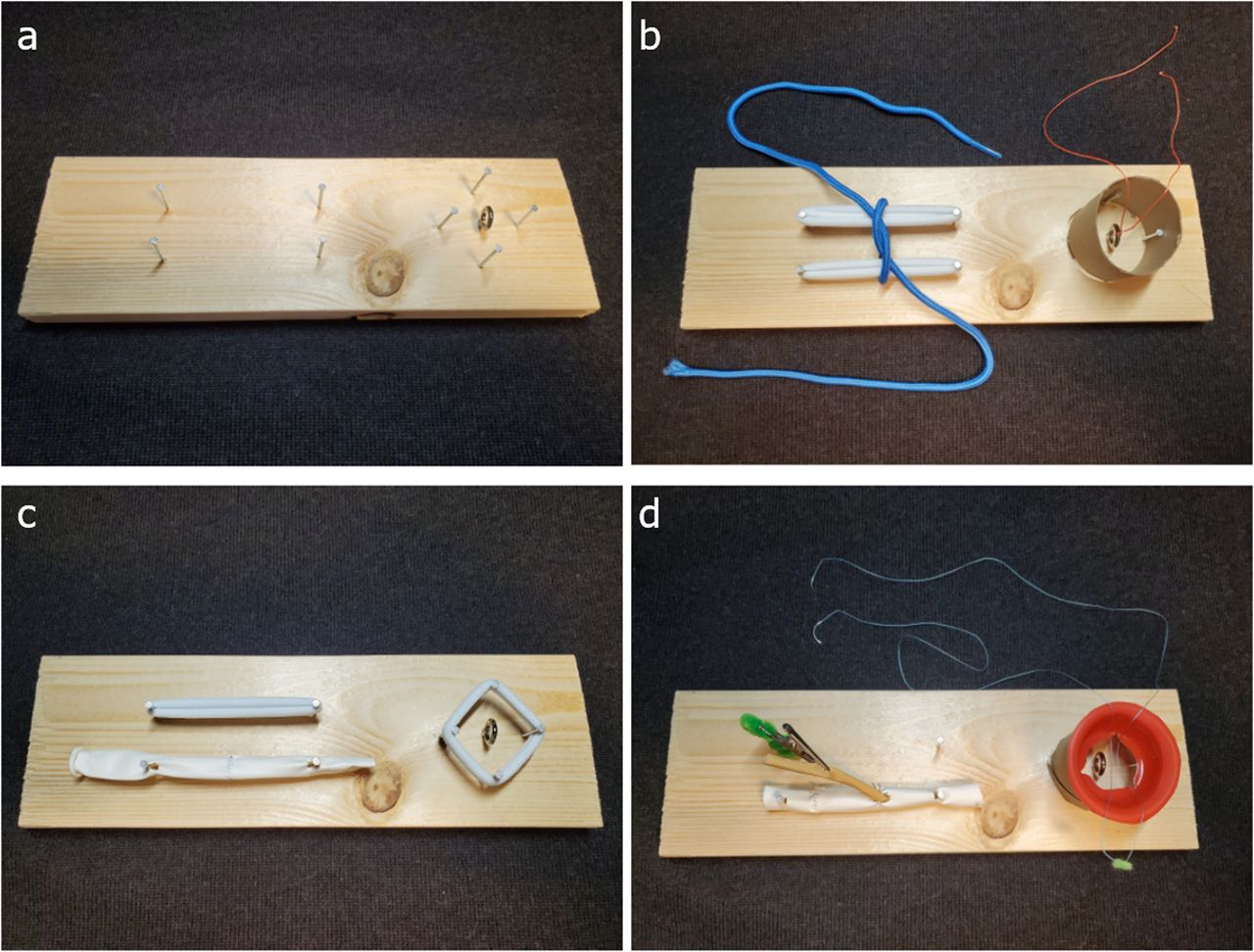
    FIGURE 2

    Sample Modules

    (a) The base of the simulator includes a wooden board (11 in x 3.5 in), nails (1.5 in), and an eye hook screw. This serves as the starting platform from which all modules are built using additional materials stored within the toolbox. (b) Medical student module #1 shows tying square knots with hair ties and a shoelace; #2 shows tying in a hole using a toilet paper roll and fishing line. (c) General surgery module #1 shows end-to-end vascular anastomosis using a linear balloon; #2 shows needle angle practice using hair ties. (d) Cardiothoracic surgery resident/fellow module #1 shows end-to-side coronary anastomosis using pipe-cleaners, alligator clip, and linear balloons; #2 shows aortic valve module using a cut cupcake holder placed inside a toilet paper roll.

  • FIGURE 3
    • Download figure
    • Open in new tab
    • Download powerpoint
    FIGURE 3

    Practicing With the GlobalSurgBox

    (a) Suturing module: Nails are positioned on the wooden board in linear/triangular shapes. Hair ties are wrapped around the nails to simulate tissue. This allows the practice of forehand, backhand, and mattress suturing. These drills can be practiced with a full-length suture to learn suture spacing or a needle with only a small suture tail to hone needle angles and forceps agility. (b) End-to-side coronary/vascular anastomosis module: A balloon is stretched across 2 nails attached to the wooden board to simulate the target vessel, while a second balloon suspended by pipe cleaners and an alligator clip serves as the graft. Using a polypropylene suture, the anastomosis is started. The alligator clip can be tilted downward to simulate “parachuting” of the graft to the target vessel.

Tables

  • Figures
  • Additional Files
    • View popup
    TABLE.

    Cost of Materials to Create 1 GlobalSurgBox

    Price, RWFa
    Hair ties (5)1,500
    Thread50
    Sport mat280
    Shoelaces150
    Balloons (7)1400
    Rubber bands (5)500
    Pen500
    Ruler500
    Wood and nails3000
    Alligator clips1500
    Sponge150
    Leather150
    Toilet paper roll150
    Total9,830a
    • ↵Abbreviation: RWF, Rwandan franc.

    • a Equal to less than US$10.

Additional Files

  • Figures
  • Tables
  • Supplemental material

    • Supplement -

      Supplement

PreviousNext
Back to top

In this issue

Global Health: Science and Practice: 10 (3)
Global Health: Science and Practice
Vol. 10, No. 3
June 29, 2022
  • Table of Contents
  • About the Cover
  • Index by Author
Print
Download PDF
Article Alerts
Sign In to Email Alerts with your Email Address
Email Article

Thank you for your interest in spreading the word about Global Health: Science and Practice.

NOTE: We only request your email address so that the person you are recommending the page to knows that you wanted them to see it, and that it is not junk mail. We do not capture any email address.

Enter multiple addresses on separate lines or separate them with commas.
Development of a Modular and Equitable Surgical Simulator
(Your Name) has forwarded a page to you from Global Health: Science and Practice
(Your Name) thought you would like to see this page from the Global Health: Science and Practice web site.
CAPTCHA
This question is for testing whether or not you are a human visitor and to prevent automated spam submissions.
Citation Tools
Development of a Modular and Equitable Surgical Simulator
Yihan Lin, Jason J. Han, John J. Kelly, Anna K. Gergen, Emily Downs
Global Health: Science and Practice Jun 2022, 10 (3) e2100744; DOI: 10.9745/GHSP-D-21-00744

Citation Manager Formats

  • BibTeX
  • Bookends
  • EasyBib
  • EndNote (tagged)
  • EndNote 8 (xml)
  • Medlars
  • Mendeley
  • Papers
  • RefWorks Tagged
  • Ref Manager
  • RIS
  • Zotero
Share
Development of a Modular and Equitable Surgical Simulator
Yihan Lin, Jason J. Han, John J. Kelly, Anna K. Gergen, Emily Downs
Global Health: Science and Practice Jun 2022, 10 (3) e2100744; DOI: 10.9745/GHSP-D-21-00744
del.icio.us logo Twitter logo Facebook logo Mendeley logo
  • Tweet Widget
  • Facebook Like
  • Google Plus One

Statistics from Altmetric.com

Jump to section

  • Article
    • ABSTRACT
    • INTRODUCTION
    • GLOBALSURGBOX SURGICAL TRAINER
    • TRAINING MODULES
    • LESSONS LEARNED
    • FUTURE DIRECTIONS
    • Author contributions
    • Competing interests
    • Footnotes
    • Notes
    • REFERENCES
  • Figures & Tables
  • Supplements
  • Info & Metrics
  • Comments
  • PDF

Related Articles

  • PubMed
  • Google Scholar

Cited By...

  • No citing articles found.
  • Google Scholar

More in this TOC Section

  • Indicators and Implementation Guidance to Advance Value-Based HIV Care Through People-Centered Metrics
  • Couple-Years of Protection Indicator: New Global Guidance for Updating Existing Methods and Adding New Methods
  • Digitalizing Clinical Guidelines: Experiences in the Development of Clinical Decision Support Algorithms for Management of Childhood Illness in Resource-Constrained Settings
Show more TECHNICAL NOTE

Similar Articles

Subjects

  • Cross-Cutting Topics
    • Surgery
Johns Hopkins Center for Communication Programs

Follow Us On

  • LinkedIn
  • Facebook
  • RSS

Articles

  • Current Issue
  • Advance Access Articles
  • Past Issues
  • Topic Collections
  • Most Read Articles
  • Supplements

More Information

  • Submit a Paper
  • Instructions for Authors
  • Instructions for Reviewers

About

  • About GHSP
  • Advisory Board
  • FAQs
  • Privacy Policy
  • Contact Us

© 2026 Creative Commons Attribution 4.0 International License. ISSN: 2169-575X

Powered by HighWire