Main menu

  • Content
    • Current Issue
    • Advance Access
    • Archive
    • Supplements
    • Special Collections
    • Topic Collections
  • For Authors
    • Instructions for Authors
    • Tips for Writing About Programs in GHSP
      • Local Voices Webinar
      • Connecting Creators and Users of Knowledge
    • Submit Manuscript
    • Publish a Supplement
    • Promote Your Article
    • Resources for Writing Journal Articles
  • About
    • About GHSP
    • Editorial Team
    • Advisory Board
    • FAQs
    • Instructions for Reviewers

User menu

  • My Alerts

Search

  • Advanced search
Global Health: Science and Practice
  • My Alerts

Global Health: Science and Practice

Dedicated to what works in global health programs

Advanced Search

  • Content
    • Current Issue
    • Advance Access
    • Archive
    • Supplements
    • Special Collections
    • Topic Collections
  • For Authors
    • Instructions for Authors
    • Tips for Writing About Programs in GHSP
    • Submit Manuscript
    • Publish a Supplement
    • Promote Your Article
    • Resources for Writing Journal Articles
  • About
    • About GHSP
    • Editorial Team
    • Advisory Board
    • FAQs
    • Instructions for Reviewers
  • Alerts
  • Find GHSP on LinkedIn
  • Visit GHSP on Facebook
  • RSS
ORIGINAL ARTICLES
Open Access

Let's Talk About Sex: Improving Measurement of Contraceptive Use in Cross-Sectional Surveys by Accounting for Sexual Activity Recency

Suzanne O. Bell, Elizabeth Larson, Shannon N. Wood and Performance Monitoring for Action Principal Investigators Group
Global Health: Science and Practice April 2022, 10(2):e2100597; https://doi.org/10.9745/GHSP-D-21-00597
Suzanne O. Bell
aDepartment of Population, Family and Reproductive Health, Johns Hopkins Bloomberg School of Public Health, Baltimore, MD, USA.
  • Find this author on Google Scholar
  • Find this author on PubMed
  • Search for this author on this site
  • For correspondence: suzannebell{at}jhu.edu
Elizabeth Larson
aDepartment of Population, Family and Reproductive Health, Johns Hopkins Bloomberg School of Public Health, Baltimore, MD, USA.
  • Find this author on Google Scholar
  • Find this author on PubMed
  • Search for this author on this site
Shannon N. Wood
aDepartment of Population, Family and Reproductive Health, Johns Hopkins Bloomberg School of Public Health, Baltimore, MD, USA.
  • Find this author on Google Scholar
  • Find this author on PubMed
  • Search for this author on this site
bContributing members listed at the end of the article.
PreviousNext
  • Article
  • Figures & Tables
  • Supplements
  • Info & Metrics
  • Comments
  • PDF
Loading

Figures & Tables

Figures

  • Tables
  • Additional Files
  • FIGURE 1
    • Download figure
    • Open in new tab
    • Download powerpoint
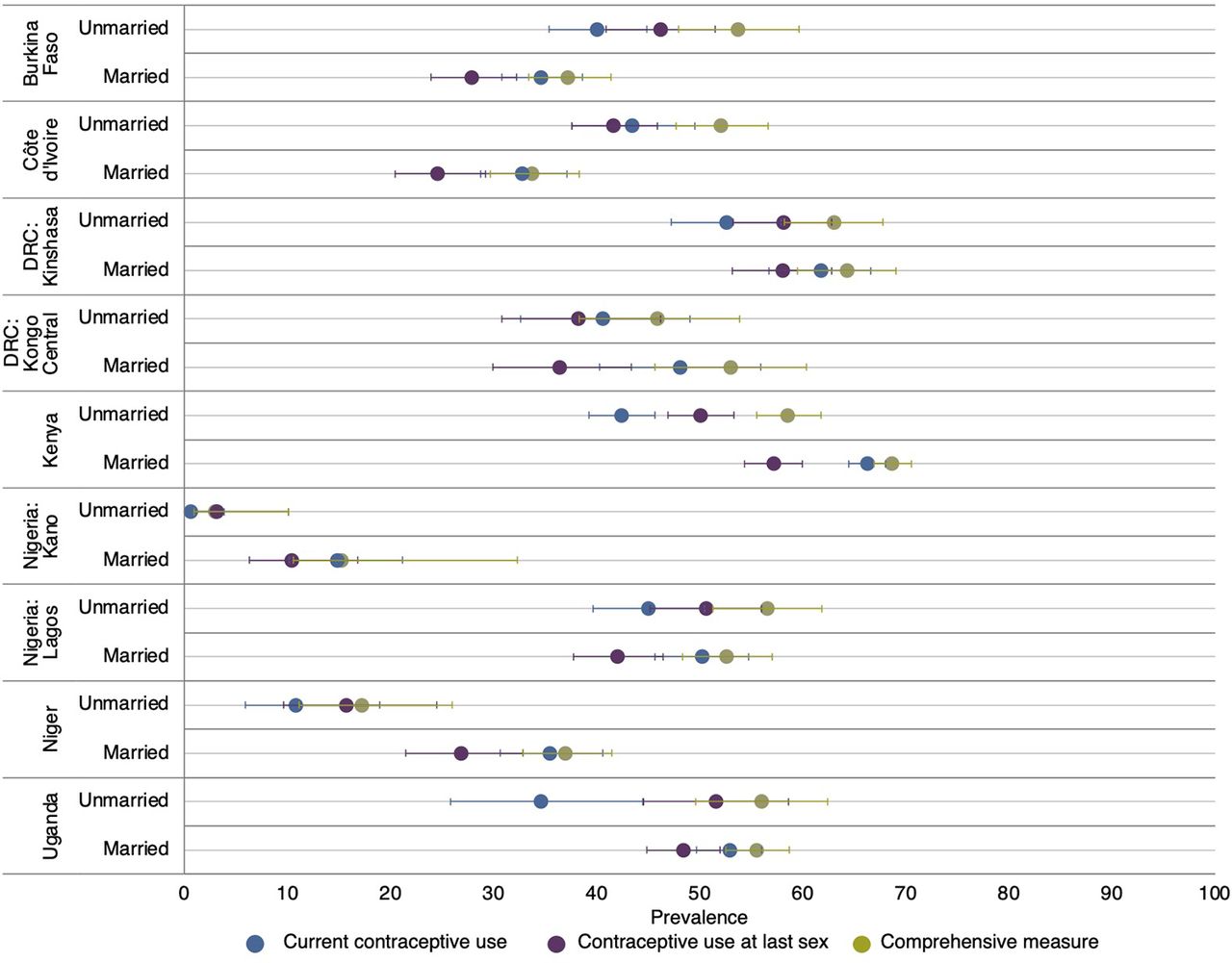
    FIGURE 1

    Contraceptive Prevalence Using Current Use, Use at Last Sex, and a Comprehensive Measure by Marital Status and Site

    Abbreviation: DRC, Democratic Republic of the Congo.

  • FIGURE 2
    • Download figure
    • Open in new tab
    • Download powerpoint
    FIGURE 2

    (A) Contraceptive Prevalence Using Current Use, Use at Last Sex, and a Comprehensive Measure by Whether Woman Had Sex in Last Month, and Site, Among Married Women; (B) Contraceptive Prevalence Using Current Use, Use at Last Sex, and a Comprehensive Measure by Whether Woman Had Sex in Last Month, and Site, Among Unmarried Women

    Abbreviation: DRC, Democratic Republic of the Congo.

  • FIGURE 3
    • Download figure
    • Open in new tab
    • Download powerpoint
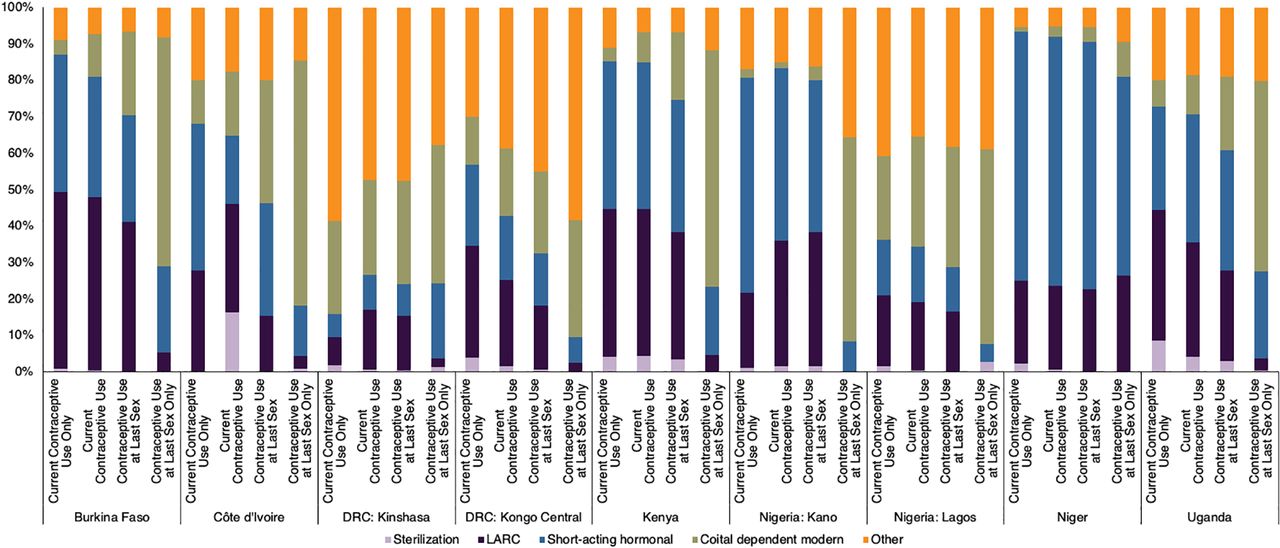
    FIGURE 3

    Contraceptive Method Mix Among Women Using Contraception According to Current Use and At Last Sex Measures, by Site

    Abbreviations: DRC, Democratic Republic of the Congo; LARC, long-acting reversible contraceptive.
Tables

  • Figures
  • Additional Files
    • View popup
    TABLE 1.

    Contraceptive Prevalence Using Current Use, Use at Last Sex, and a Composite Measure Among All Presumably Fecund Women Aged 15–49 Years Who Have Ever Had Sex, by Site

    Burkina Faso (N=5,016) % (95% CI)Côte d'Ivoire (N=3,320) % (95% CI)DRC: Kinshasa (N=1,950) % (95% CI)DRC: Kongo Central (N=1,555) % (95% CI)Kenya (N=7,380) % (95% CI)Nigeria: Kano (N=738) % (95% CI)Nigeria: Lagos (N=1,126) % (95% CI)Niger (N=851) % (95% CI)Uganda (N=2,922) % (95% CI)
    Current contraceptive use35.4 (31.8, 39.1)36.34 (32.9, 39.7)57.24 (53.2, 61.1)45.74 (38.7, 52.9)58.84 (56.9, 60.6)14.04 (9.6, 19.9)48.84 (44.9, 52.6)31.74 (27.7, 35.9)46.94 (42.6, 51.2)
    Contraceptive use at last sex30.44 (26.6, 34.6)30.14 (26.5, 34.0)58.14 (54.3, 61.8)37.04 (30.8, 43.7)55.04 (52.3, 57.6)10.04 (6.1, 16.0)44.54 (40.6, 48.4)25.14 (20.4, 30.5)49.54 (45.3, 53.7)
    Comprehensive contraceptive use39.64 (35.8, 43.6)39.84 (36.3, 43.3)63.84 (59.8, 67.6)50.84 (43.9, 57.6)65.64 (63.7, 67.4)14.64 (10.1, 20.6)53.84 (50.0, 57.6)34.04 (30.3, 38.0)55.84 (52.4, 59.2)
    • Abbreviations: CI, confidence interval; DRC, Democratic Republic of the Congo.

    • View popup
    TABLE 2.

    Marital Status and Sexual Recency of Presumably Fecund Women Aged 15–49 Years Who Have Ever Had Sex, by Site

    Burkina Faso (N=5,016) % (95% CI)Côte d'Ivoire (N=3,320) % (95% CI)DRC: Kinshasa (N=1,950) % (95% CI)DRC: Kongo Central (N=1,555) % (95% CI)Kenya (N=7,380) % (95% CI)Nigeria: Kano (N=738) % (95% CI)Nigeria: Lagos (N=1,126) % (95% CI)Niger (N=851) % (95% CI)Uganda (N=2,922) % (95% CI)
    Currently married/cohabiting86.04 (83.8, 88.0)67.84 (64.6, 70.9)49.54 (46.1, 52.9)67.54 (62.4, 72.3)68.54 (67.0, 70.1)94.04 (90.7, 96.1)71.74 (68.6, 74.7)84.64 (80.4, 87.9)67.04 (61.0, 72.5)
    Had sex in last month
        All women60.24 (56.3, 63.9)66.44 (63.7, 68.9)68.14 (64.9, 71.1)72.24 (68.7, 75.4)69.74 (68.2, 71.2)84.34 (80.9, 87.2)68.34 (65.0, 71.3)68.44 (63.0, 73.3)64.94 (58.6, 70.8)
        Married/cohabiting63.24 (58.9, 67.4)76.44 (72.8, 79.6)85.64 (83.4, 87.5)85.04 (81.0, 88.3)85.44 (83.9, 86.7)88.44 (84.6, 91.4)81.24 (78.2, 83.9)79.34 (73.2, 84.3)82.54 (79.0, 85.5)
        Not married/cohabiting41.54 (35.9, 47.2)45.24 (41.7, 48.8)50.94 (46.0, 55.9)45.54 (39.4, 51.6)35.54 (32.7, 38.4)20.94 (7.3, 47.0)35.54 (30.3, 41.1)8.84 (4.2, 17.6)29.24 (20.2, 40.3)
    • Abbreviations: CI, confidence interval; DRC, Democratic Republic of the Congo.

Additional Files

  • Figures
  • Tables
  • Supplemental material

    • Supplement -

      Supplement

PreviousNext
Back to top

In this issue

Global Health: Science and Practice: 10 (2)
Global Health: Science and Practice
Vol. 10, No. 2
April 28, 2022
  • Table of Contents
  • About the Cover
  • Index by Author
Print
Download PDF
Article Alerts
Sign In to Email Alerts with your Email Address
Email Article

Thank you for your interest in spreading the word about Global Health: Science and Practice.

NOTE: We only request your email address so that the person you are recommending the page to knows that you wanted them to see it, and that it is not junk mail. We do not capture any email address.

Enter multiple addresses on separate lines or separate them with commas.
Let's Talk About Sex: Improving Measurement of Contraceptive Use in Cross-Sectional Surveys by Accounting for Sexual Activity Recency
(Your Name) has forwarded a page to you from Global Health: Science and Practice
(Your Name) thought you would like to see this page from the Global Health: Science and Practice web site.
CAPTCHA
This question is for testing whether or not you are a human visitor and to prevent automated spam submissions.
Citation Tools
Let's Talk About Sex: Improving Measurement of Contraceptive Use in Cross-Sectional Surveys by Accounting for Sexual Activity Recency
Suzanne O. Bell, Elizabeth Larson, Shannon N. Wood, Performance Monitoring for Action Principal Investigators Group
Global Health: Science and Practice Apr 2022, 10 (2) e2100597; DOI: 10.9745/GHSP-D-21-00597

Citation Manager Formats

  • BibTeX
  • Bookends
  • EasyBib
  • EndNote (tagged)
  • EndNote 8 (xml)
  • Medlars
  • Mendeley
  • Papers
  • RefWorks Tagged
  • Ref Manager
  • RIS
  • Zotero
Share
Let's Talk About Sex: Improving Measurement of Contraceptive Use in Cross-Sectional Surveys by Accounting for Sexual Activity Recency
Suzanne O. Bell, Elizabeth Larson, Shannon N. Wood, Performance Monitoring for Action Principal Investigators Group
Global Health: Science and Practice Apr 2022, 10 (2) e2100597; DOI: 10.9745/GHSP-D-21-00597
del.icio.us logo Twitter logo Facebook logo Mendeley logo
  • Tweet Widget
  • Facebook Like
  • Google Plus One

Statistics from Altmetric.com

Jump to section

  • Article
    • ABSTRACT
    • INTRODUCTION
    • METHODS
    • RESULTS
    • DISCUSSION
    • CONCLUSION
    • PMA Principal Investigators group who contributed to the development of this manuscript
    • Acknowledgments
    • Funding
    • Author contributions
    • Competing interests
    • Notes
    • REFERENCES
  • Figures & Tables
  • Supplements
  • Info & Metrics
  • Comments
  • PDF

Related Articles

  • PubMed
  • Google Scholar

Cited By...

  • No citing articles found.
  • Google Scholar

More in this TOC Section

  • Baseline Assessment of Evidence-Based Intrapartum Care Practices in Medical Schools in 3 States in India: A Mixed-Methods Study
  • The Equity Tool for Valuing Global Health Partnerships
  • Casting a Wide Net: HIV Drug Resistance Monitoring in Pre-Exposure Prophylaxis Seroconverters in the Global Evaluation of Microbicide Sensitivity Project
Show more Original Articles

Similar Articles

Subjects

  • Health Topics
    • Family Planning and Reproductive Health
Johns Hopkins Center for Communication Programs

Follow Us On

  • LinkedIn
  • Facebook
  • RSS

Articles

  • Current Issue
  • Advance Access Articles
  • Past Issues
  • Topic Collections
  • Most Read Articles
  • Supplements

More Information

  • Submit a Paper
  • Instructions for Authors
  • Instructions for Reviewers

About

  • About GHSP
  • Advisory Board
  • FAQs
  • Privacy Policy
  • Contact Us

© 2026 Creative Commons Attribution 4.0 International License. ISSN: 2169-575X

Powered by HighWire